
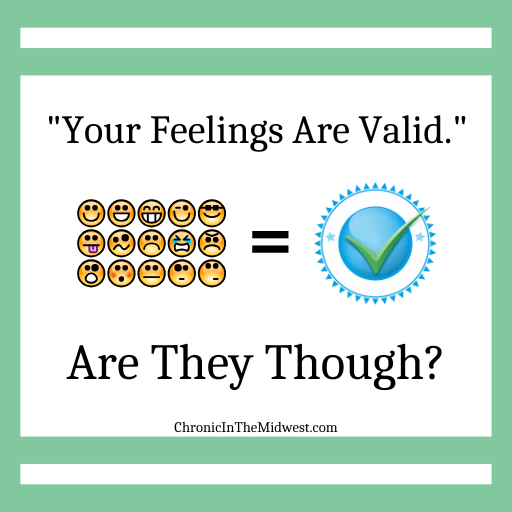
I’m not sure how “Your feelings are valid” has gained so much traction this past year or two. But let’s talk about it real quick.
“Your feelings are valid” is often said by well-meaning friends or therapists to help you feel validated after you share something that stirs up some strong feelings in you. The idea is to eliminate the shame of sharing your feelings and to avoid gaslighting (which you might accomplish by saying, “Well, you shouldn’t feel that way!”).
And while I get the idea behind the phrase, I actually dislike it and believe it needs to be circulated out of everyday use.
Imagine you start drinking a cup of coffee. Suddenly, you’re enraged about the coffee. You’re talking to your therapist, and you explain that this coffee just absolutely gets your goat. You no longer like it or want to taste it, smell it, or see it. The coffee brings tears to your eyes, and you don’t even know why. Your therapist nods with empathy and says, “Yes, I hear you. Your feelings are valid.”
But…what are they valid about??
Here’s the thing. Every feeling we have is very real. I don’t think anyone would claim that we are hallucinating emotions; you just can’t. Even when you’re detached from yourself, you “feel”. Maybe you feel emptiness, or you feel shut down. But we’re always feeling.
So to say that feelings are real or that they exist is to say that we need air to breathe. It goes without saying.
What are “valid” feelings? Something that is “valid” is sound, just, well-founded, authoritative, and effective.1 Does it make sense to say that all of our feelings are valid?
Not really. Going back to the coffee example, it is not sound, just, or well-founded to get angry about a cup of coffee. There is no authority found in that sudden and chaotic burst of emotion. Getting angry at the coffee does not provide an effective understanding of the circumstance. But here’s how we can look at it….
The anger about the coffee may be very real. But the anger is only a hint. We need to dig deeper to figure out where the anger is coming from. It’s not common to get angry at a cup of coffee. So we consider that maybe the coffee is bringing up emotions connected to something. Maybe your ex broke up with you over a cup of coffee. Maybe coffee brings forward traumatic flashbacks from abuse. Perhaps the coffee makes you feel like a failure if you were always drinking coffee when you got yelled at by a former boss.
While the anger itself is real and exists, that doesn’t mean it’s valid for that situation. In fact, we could say that the anger is invalid, and we need to explore deeper and figure out a different way to react to the cup of coffee. (DBT skills to the rescue!)
To me, “Your feelings are valid” is a nonsensical phrase. Based on what validity even is, our feelings are often not valid at all. Our feelings can inform us, but we shouldn’t think with them. Our feelings might help us see that something is going on in our brains, but they are a symptom and not the cause.
I think we can say “Thank you for sharing” or other expressions of empathy (e.g., “That sounds really hard”; “Do you know why you feel that way?”; “Thank you for trusting me with that”). And if it turns out someone’s emotions are valid for the situation (e.g., anger when someone you love has been hurt; fear of an upcoming medical procedure), then we can use that phrase in a way that makes sense.
What do you think? Is that a phrase you use? Do you disagree with the post? Share in the comments!

 Chronic in the Midwest