Late on January 18, 2025, TikTok was officially banned by the U.S. government. And roughly 12 hours later, it was reinstated (for 90 days so far).
Leading up to the ban, there was nothing short of emotional turmoil. Influencers said fond farewells and shared the social media platforms they would be migrating to. Users shared videos of themselves crying as they feared the loss of their primary source of income. Many shared their anger toward the government, wondering if the U.S. was even allowed to ban a social media platform.
Let me start by saying that you must do your own research. Do not rely on me, on social media, on TikTok, on anyone to think for you. If you see a headline and feel outraged, that is a sign that you need to do some more research, not go flocking to your favorite social media platform to immediately share your outrage and potentially look like a fool (preaching to myself as well here). It’s better to share the correct information than to give the wrong details and have to backpedal later.
Research, research, research. Remember, research doesn’t slow you down. You’re going at just the right pace to get the right information.
Back to TikTok. Many rejoiced over the ban. While some people stated some rather hurtful things (claiming influencers now had to get “a real job”), others made some pretty good points. Although TikTok was banned for security issues, there is something to be said about the effect on our mental health.
The Mental Health Consideration
Studies have shown that social media can have an adverse effect on our mental health, especially in adolescents with their minds still developing. Kids and teens usually don’t know how to say “no” to things, and their concept of self is still developing. Self-control is not something they have come close to mastering. Adults struggle to put down their phones, so it’s easy to understand how this can be a challenge for teenagers.
Is social media bad for us? The studies1 may take a long time to come to conclusions. They need to examine a large population over a long period of time on several different social media platforms. However, I don’t think we need to wait for the official conclusions of what we already know to be true2. And yet I will always encourage you to think for yourself.
How Does Social Media Affect Us?
Building on social media (building a community, an income, and so on) is like building a house on the sand. If it shifts, as social media often does, you risk losing what you’ve built. While it can be a beneficial supplement, it is a risk to rely on. We also, and perhaps especially, have to consider how social media changes us.
Think of how you talk to people in person, especially complete strangers. Think of what you assume about their motives (if they are not acting shady). We are often inclined to be more polite in person, knowing that we will get immediate feedback from anyone we are rude to. Now compare that to how you perceive people through a screen. Are you inclined to treat people better through a screen?
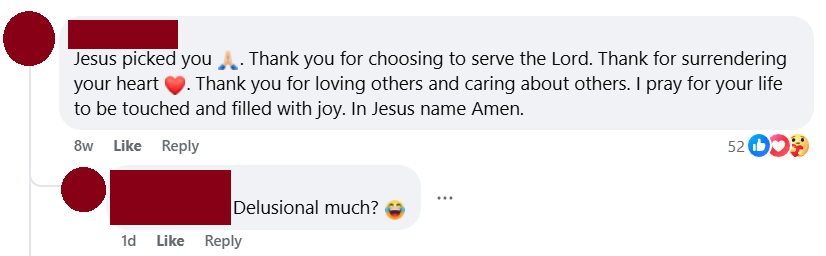
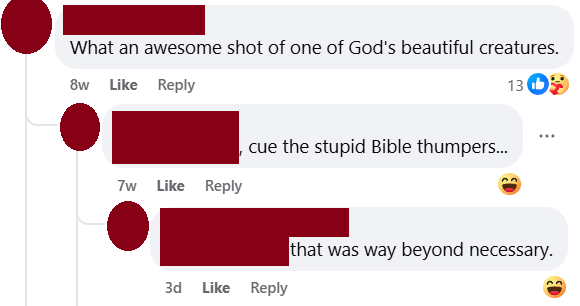
On nearly any public post on Facebook, it doesn’t take long to find a nasty thread. Someone comments, another responds, and what follows is a domino effect of misunderstandings and prideful words. A quick scroll down my Facebook feed showed me several posts from different public pages. May I just say…heaven forbid you say literally anything that someone might disagree with. Social media can be a Colosseum packed with spectators ravenous for the kill. Here are examples of comments I found on various posts:

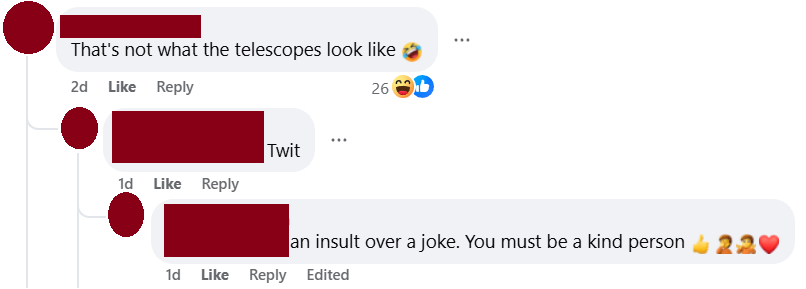

In fact, sometimes you don’t even need to read down a whole comment thread; a single comment can be the nasty start. Say someone shares a cute video of a mom playing with her baby. You will often find comments like:
- “Wow, where’s the dad?”
- “I wish I could waste time sitting around.”
- “That house is a mess!”
- “Did you hear the toddler saying her name? She’s just ignoring that poor child to favor the baby!”
- “She’s being far too rough!”
- “That baby looks too hot/too cold.”
- “See how big the baby’s eyes are? It’s clearly scared of the mom!”
(These are all comments I’ve seen before!) A slew of assumptions will often come from a clip that may be just seconds long.
It begs a question: Are most people like this? And the answer itself is almost the problem. Simply put, are most of the nasty people you see on social media “most people”, or are they merely a small sample of the population? Perhaps they are a much smaller sample than we realize. And we are unable to truly know each and every one of them. Yet we engage in these interactions as though we are in a comfortable and casual relationship.
Most humans are not able to navigate an army of people on a daily basis. There is a reason commanders are fewer in number. Many of us get overwhelmed at the sheer thought of thousands of people in one space, much less watching close interactions between all of those people.
Online data gathering platform Statista states:
“The average number of data interactions per connected person per day is expected to increase dramatically, from 298 interactions per day in 2010 to almost five thousand interactions per day by 2025.”3
Can you imagine the mental and emotional exhaustion of nearly 5,000 online interactions per day? That sounds exhausting enough offline. It’s no wonder people resort to fighting, having nothing of value left to contribute when they are socially spent.
While this is not an exhaustive look at mental health and social media, I do hope you’ll consider the facts and the anecdotal experiences at hand. No matter what the studies may conclude, consider whether social media has expanded beyond our capacity to handle it. Some questions to ask:
- Do I “doomscroll” daily on my phone?
- Do I feel like I need to comment on a post so people know “the truth”?
- Am I okay with not getting my opinion out into the world?
- Do I get angry and defensive in my social interactions?
- Am I adding to the conversation, or am I just making noise?
- What is my heart posture in this (prideful? wanting to shut someone down? angry? or loving? kind? helpful?)?
- Why does someone’s opinion make me so mad?
- Why do I feel like I need to tell people they’re wrong?
- Would I be embarrassed if someone I know in “real life” saw what I wrote on this comment?
- Do I talk to people more online than I do in person? (If you’re physically able to leave the house often, of course.)
- Would I say this to someone in person, or would I phrase it differently?
- When is the last time I got outside?
- Do my kids/teens know how to socialize or be bored?
- Do I know how to socialize or be bored?
- If TikTok gets banned again, how might I react, and is that reaction healthy?
- Am I healthy enough to make useful contributions on social media?
I would ask similar questions even in the emoji reactions you choose to use.
It’s also worth considering heavier topics: Should a person make all of their living on social media? Should teens under 18 be allowed to use social media? Was the reaction to the U.S. TikTok ban normal and healthy? Did we learn anything about ourselves from the temporary ban?
This is definitely a topic to revisit another day. For now, please consider those questions, and ask yourself your own questions to gauge your mental and social health surrounding your social media use.
Footnotes:
- The impact of the digital revolution
on human brain and behavior: where
do we stand?
Social Media Use and Its Connection to Mental Health: A Systematic Review
Social Media and Mental Health: Benefits, Risks, and Opportunities for Research and Practice ↩︎ - Why young brains are especially vulnerable to social media ↩︎
- Daily digital data interactions per connected person worldwide from 2010 to 2025 ↩︎
More articles for additional research:
- How Social Media Use Affects Adolescent Brain Development
- Study shows habitual checking of social media may impact young adolescents’ brain development
- How Social Media Affects Your Teen’s Mental Health: A Parent’s Guide
- Mounting Research Documents the Harmful Effects of Social Media Use on Mental Health, Including Body Image and Development of Eating Disorders
- Is social media bad for you? The evidence and the unknowns
- Just How Harmful Is Social Media? Our Experts Weigh-In.

 Chronic in the Midwest